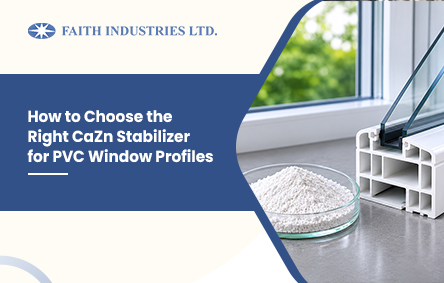
Plenty of window profile plants moved away from lead in recent years, and many went through the same rough patch afterwards. The compound ran well on day one. Then the complaints started: a faint yellow tint on white frames, die deposits that needed cleaning every shift, welded corners that cracked under a simple strength test.
In most of those cases the calcium zinc stabilizer for PVC wasn’t poor. It was picked the way a lead stabilizer used to be picked, and the two behave very differently. This guide shows how to choose a CaZn stabilizer for window profile production so you avoid that rough patch, using the checks, trials and fixes that matter on the shop floor.
What Changes When You Switch from Lead to CaZn
Lead gave processors a lot of room for error. You could run a slightly hot barrel, let the melt sit in the die a little longer, and the profile still came out white. CaZn systems give you much less of that room. Three things change in daily running:
- The heat window is narrower. Zinc-based protection reacts badly to long residence time and hot spots, so a dead corner in the die that lead tolerated can now burn the material.
- Lubricants arrive inside the pack. A CaZn one-pack usually carries lubricants along with the stabilizer, so it changes how the melt flows and fuses.
- Weathering needs fresh proof. Lead had decades of outdoor history. A CaZn system has to show its own colour-retention data.
None of this makes CaZn a weaker choice. It means the selection needs more care than a price comparison.
How a Calcium Zinc Stabilizer Protects PVC
Think of two workers on one job. When PVC is heated, weak spots on the polymer chain start to break down and release hydrogen chloride, which speeds up the damage. Zinc steps in first. It fixes those weak spots early, and that keeps a fresh profile bright white. Calcium works more slowly. It mops up the hydrogen chloride and the by-products that build up as the run continues.
The catch sits with zinc. Its by-product, zinc chloride, speeds up the breakdown when it piles up faster than calcium can clear it. The compound then goes from white to dark brown within minutes. Processors call this zinc burning. Co-stabilizers such as polyols, β-diketones and epoxidised soybean oil (ESBO) are added to hold it back.
What this means for you is simple. A good CaZn stabilizer for window profile use keeps calcium, zinc and co-stabilizers in balance, and that balance only holds when the melt isn’t sitting too long or running too hot.
6 Things to Check Before You Choose a CaZn Stabilizer for PVC Window Profiles
Most buyers compare price and datasheets. These six checks come from problems that show up after the switch, and few suppliers bring them up.
1. See how it behaves on your worst day
Any stabilizer looks good on a smooth trial. The real test is a line stoppage, a hot afternoon or a new die. Ask how the system holds when residence time grows and melt temperature drifts upward, and ask to see the colour result, not just a rated stability time.
2. Compare cost per metre of profile
A CaZn one-pack is dosed at a higher level than a pure tin stabilizer. A cheaper pack that needs a higher dose and causes more die cleaning rarely stays cheap. Add dosage, scrap and cleaning stops together, then divide by metres produced.
3. Don’t stack your old lubricants on a new one-pack
This is one of the most common mistakes after a switch. The one-pack already contains lubricants. If you keep adding the same external lubricant you used with lead, the formula becomes over-lubricated, which means late fusion, a rough surface and weak weld corners. Ask the supplier for a starting lubricant level and adjust from there.
4. Ask about moisture and storage
Some co-stabilizers, polyols and zeolites in particular, pick up moisture from the air. Damp material can leave bubbles and pitting on the profile. If your store room is humid, ask how the calcium zinc stabilizer for PVC is packed, what shelf life to expect and whether the compound needs drying.
5. Know where your regrind comes from
Reusing your own clean trim is simple. Buying outside regrind is different, because older profiles often contain lead. The EU has capped lead in PVC articles at 0.1% since 29 November 2024, with a limited allowance for certain recovered rigid PVC articles until May 2033. If you export to Europe, test your regrind before it goes into the mix.
6. Check the colour inside the wall
A CaZn profile can show a different tint inside the wall than on the visible face, often yellowish or bluish. Cut a sample and compare both sides. Then ask for weathering data against the EN 12608-1 colour limits, which allow a total colour change (dE*) of up to 5 and a yellow-blue shift (db*) of up to 3.
A Practical Trial Plan Before You Order in Bulk
A trial should answer one question: will this compound hold up in your plant, on your line? Four steps get you there.
- Record a baseline. Note barrel and die temperatures, screw speed, melt pressure and motor load on your current compound.
- Change only the stabilizer. Run the same settings with the new CaZn system. Watch torque and pressure, and compare the profile after the first hour and again after the fourth.
- Stress it a little. Under supervision, slow the line to lengthen residence time and nudge temperatures up slightly. Note the point where colour starts to shift. That is your real safety margin.
- Test the finished profile. Most window buyers refer to EN 12608-1, and US buyers usually refer to ASTM D4726. The EN limits give you a clear benchmark.
| What to measure | Benchmark (EN 12608-1, light-coloured profiles) | What it tells you |
| Colour of visible face | L* at least 82, a* from -2.5 to 5, b* from -5 to 15 | Starting whiteness and tint |
| Behaviour after heating at 150 °C | No defects | Heat robustness of the finished profile |
| Weld strength | Tensile bending at least 25 N/mm², compression bending at least 35 N/mm² | Fusion quality at corners |
| Colour change after artificial weathering | dE* up to 5, db* up to 3 | Long-term whiteness |
Keep a retained sample from every batch. When a new lot arrives, repeat the same checks, and ask your PVC stabilizer manufacturer for the certificate of analysis whenever something changes.
Troubleshooting: Defect, Likely Cause and First Fix
When something goes wrong after a switch, work through this table from left to right and change one thing at a time.
| What you see | Likely cause | Check first | Likely fix |
| Sudden dark streaks mid-run | Zinc burning from excess heat or stagnant spots in the die | Melt temperature trend, dead corners in adaptor and die | Lower hot zones, clear dead spots, review co-stabilizer level, purge the line |
| Slow yellow tint over a long run | Heat load building up, often with high regrind share | Regrind percentage, temperature creep | Cut the regrind share, correct temperatures, ask for a higher heat-hold grade |
| Lines on surface, deposits at die lip | Plate-out from lubricant excess or a stabilizer-lubricant mismatch | Die lip against die body temperature, external lubricant level, any new raw material lot | Raise die lip temperature slightly, trim external lubricant, compare lot certificates |
| Rough surface, brittle weld corners | Late fusion, usually from over-lubrication | Gelation level (acetone test), total lubricant added | Reduce the lubricant stack, raise fusion temperature a little |
| Bubbles and pitting | Moisture picked up by additives | Storage conditions, dryness of the compound | Dry the material, improve storage |
| Different colour inside the wall | Uneven heat history across the section | Cross-section colour, calibration cooling | Adjust cooling and temperature profile |
Choosing for Your Climate and Market
Two climates matter here: where the window will be installed and where your plant runs. EN 12608-1 uses two exposure classes for weathering tests, moderate and severe, so ask your supplier for data that matches your destination.
| Market | What matters most | What to ask for |
| Qatar, Kuwait | Intense sun and heat | Weathering data at severe-climate level, whiteness retention |
| Bangladesh, Vietnam, Thailand, coastal Kenya | Humidity in storage, plus heat and sun | Moisture and storage guidance, heat-hold at longer residence time |
| Russia | Cold winters, condensation when cold bags enter a warm hall | Impact retention data, advice on letting bags reach hall temperature before opening |
| USA | Strict colour expectations in specifications | Colour data against the specification your buyer names |
| India | Wide climate range, very hot summers inside the plant | A trial run in your hottest months |
Why Businesses Choose FAITH Industries for CaZn Stabilizer for PVC Window Profiles
Picking a PVC stabilizer manufacturer really means choosing who helps you solve problems like the ones above. FAITH Industries Ltd. is a PVC additives manufacturer that makes stabilizers, lubricants, impact modifiers, CPVC compound and waxes at a single plant. Lubricant fit and impact modifier balance both affect how a stabilizer performs, so having them under one roof lets a single team tune the whole recipe. Our in-house R&D centre supports trials, and we supply customers in over 35 countries, with recognition from the Indian Government and international credit rating agencies.
FAQs
1. Is a CaZn stabilizer better than lead for PVC window profiles?
It depends on what you compare. For health and regulation, yes. The EU has capped lead in PVC articles at 0.1% since November 2024. For processing, lead has always been more forgiving, so a calcium zinc stabilizer for PVC needs closer control of temperature, lubricants and co-stabilizers. Many processors have made the switch successfully once the whole formulation was adjusted
2. Can I replace a lead stabilizer with a CaZn stabilizer at the same dosage?
Not safely. A one-for-one swap that keeps the old lubricants and machine settings is a common reason for defects after the switch. A CaZn one-pack usually carries its own lubricants and behaves differently during fusion. Start from your supplier’s recommended dose and lubricant level, then fine-tune through a trial run.
3. Why does my window profile turn yellow or show dark streaks after the switch?
Heat, time and balance are the usual causes. Check melt temperature, stagnant spots in the die, regrind share and lubricant level first. Sudden dark streaks often point to zinc burning, which happens when excess heat or long residence lets zinc chloride build up. Slow yellowing usually points to cumulative heat load or a lubricant imbalance.
4. How much CaZn stabilizer should I add to a window profile recipe?
There is no single number. It depends on the grade, your resin, fillers, TiO₂, impact modifier and line. Published datasheets for window profile one-packs often show roughly 3 to 4 phr, but treat that as a ballpark, not a rule. Follow your supplier’s technical datasheet, confirm it in a trial, and judge the result by cost per metre of profile.
5. Can I use lead-stabilised regrind with a CaZn stabilizer?
This is mainly a compliance question. The EU limit of 0.1% lead in PVC articles applies from 29 November 2024, with a limited allowance for certain recovered rigid PVC until May 2033. If you export to Europe, test the lead content of outside regrind first. Your own clean CaZn regrind has no lead issue, but it adds heat history, so check colour at your actual regrind ratio.