In PVC offering, production efficiency depends on more than just the quality of the resin or stabilizer. The lubrication system also plays a major role in determining how smoothly the material moves through the extruder, how cleanly it leaves the die, and how consistent the finished product remains across long production runs. This is why selecting the right grade of polyethylene wax is an important formulation decision rather than a routine material choice.
Polyethylene wax is an external lubricant used in rigid PVC formulations to reduce the friction between the molten compound and the processing equipment, unlike general purpose lubricants. Achieving the right balance can support stable processing, improve surface finish and reduce unplanned production interruptions, but an unsuitable grade or wrong dosage may cause processing problems instead of solving them. Therefore, producers who need consistent product quality need to understand where and how polyethylene wax performs best.
Where is Polyethylene Wax Used in PVC Offering?
The same grade of polyethylene wax does not perform equally well across every PVC product. Processing conditions, die design, filler loading, and production speed vary significantly between pipes, profiles, sheets, and moulded components. For this reason, producers select polyethylene wax based on the processing behaviour they want to achieve rather than simply adding it as a standard lubricant. Working with an experienced PE wax manufacturer also helps ensure that the selected grade is suitable for the intended PVC application. Understanding where it is used and why helps build a more balanced and reliable PVC formulation.
PVC Pipes and Fittings
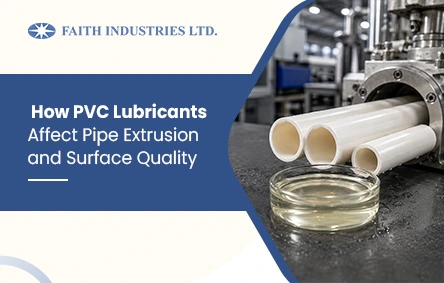
Usually it is a continuous process with machines working for long hours without much interruption. During long production runs, a problem is the gradual build-up of material on the die lips, which is called plate-out. This can affect the surface quality and increase the number of cleaning cycles. A suitable polyethylene wax grade helps to reduce metal-to-melt friction at the die surface allowing the compound to flow more consistently. It permits longer production runs with less interruption, and a smoother pipe surface and more uniform dimensions.
uPVC Window and Door Profiles
Unlike pipes, uPVC profiles pass through complex dies containing multiple chambers and thin wall sections. These intricate designs require the PVC melt to flow evenly into every part of the profile. If lubrication is not properly balanced, some sections may fill unevenly or the fusion process may be delayed, leading to visible surface defects or dimensional variation. Polyethylene wax is therefore selected to improve external lubrication without disturbing the overall processing balance established by the complete lubricant package.
PVC Sheets and Panels
PVC sheets demand a uniform surface because even minor flow disturbances become visible after printing, lamination, or thermoforming. During sheet extrusion, consistent movement of the melt through the die is essential to minimize drag marks and surface irregularities. A carefully selected polyethylene wax grade helps the material leave the die more smoothly, improving surface consistency while supporting stable production over long offering cycles.
Cable Compounds
PVC cable insulation must be extruded uniformly around the conductor to achieve consistent thickness throughout the cable length. Variations in material flow can affect dimensional consistency and increase process adjustments. Polyethylene wax helps maintain smoother movement of the compound through the extrusion system, making production more stable and reducing unnecessary fluctuations during continuous operation.
Injection-Moulded PVC Products
The processing requirements are different in injection moulding as the PVC compound has to fill the mould cavity very fast before solidification. A too high friction during mould filling may affect the quality of the part, while a too low lubrication may increase the resistance during demoulding. Choosing the right grade of polyethylene wax provides a balanced flow during injection and a cleaner mould release, allowing for more consistent production of fittings, electrical accessories and other rigid PVC components.
How to Select the Right Polyethylene Wax for PVC Formulations?
Two polyethylene wax products may look almost identical on a technical data sheet, yet deliver different processing results on the same extrusion line. This is because PVC processing depends on the overall lubrication balance, not on a single wax property. Experienced formulators evaluate polyethylene wax as part of the complete formulation instead of selecting it in isolation.
Processing Temperature Matters More Than the Highest Melting Point
A common misconception is that a higher melting point always means better performance. In reality, the wax should match the processing window of the PVC formulation. If lubrication begins too early, PVC fusion may be delayed. If it begins too late, friction inside the processing equipment can increase before the lubricant becomes effective. The objective is to maintain a stable processing window rather than simply choosing the wax with the highest specification.
One Grade Does Not Fit Every PVC Formulation
Pipe compounds, window profiles, cable compounds and injection-moulded products are processed under different conditions. Lubricant requirements can change with the calcium carbonate loading, processing aids, stabilizer systems or machine output. Therefore, producers rarely use a single grade of polyethylene wax for all PVC applications even though the same resin is used. Understanding the uses of PE wax helps formulators select a grade that corresponds to the processing needs of each application, not a one-size-fits-all.
Evaluate the Entire Lubricant Package
In most PVC formulations, polyethylene wax works alongside internal lubricants and other processing additives. Whether the formulation uses lead-based systems or is developed by a PVC stabilizer manufacturer using calcium-zinc technology, replacing only the wax without reviewing the complete formulation can change fusion behaviour, melt flow, or die cleanliness. Many processing issues attributed to polyethylene wax are caused by an imbalance between external and internal lubrication rather than the wax itself.
Product Form Should Match Plant Operations
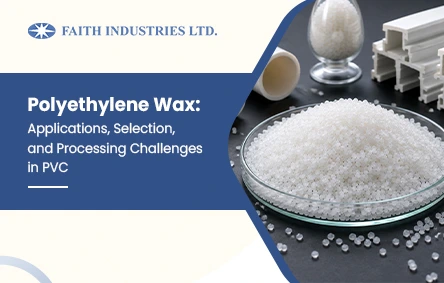
Polyethylene wax is supplied in powder, flakes, and granules. While lubrication performance is the primary consideration, handling efficiency is also important. Powder generally disperses quickly during dry blending, whereas flakes and granules are often preferred where dust control, storage, or automated feeding systems are priorities.
Production Trials Confirm the Right Choice
Laboratory specifications are a good guide but will not predict plant performance completely. Experienced producers check fusion behaviour, die build-up, product finish and processing stability under actual production conditions before each new wax grade is cleared for regular use. Formulation support can also be helpful from an experienced PE wax manufacturer or a PVC additives manufacturer to select a suitable grade for particular PVC processing needs.
Processing Challenges Related to Polyethylene Wax in PVC
When a processing problem appears on the production line, polyethylene wax is often the first raw material that comes under scrutiny. However, experienced PVC processors know that changing the wax is rarely the first solution. Lubrication performance depends on the interaction between stabilizers, processing aids, fillers, machine settings, and the selected wax grade. A systematic evaluation usually delivers better results than adjusting a single additive.
Plate-Out on Dies During Continuous Production
Problem: Deposits gradually build up on the die lips, reducing surface quality and increasing machine cleaning time.
Possible Causes: Excess external lubrication, changes in stabilizer chemistry, inconsistent filler quality, or processing temperatures outside the recommended operating range.
What to Check First: Before reducing polyethylene wax dosage, review recent formulation changes, verify the temperature profile, and confirm that raw material quality remains consistent between batches.
Delayed Fusion and Unstable Processing
Problem: The PVC compound takes longer to fuse, causing unstable extrusion and variations in product dimensions.
Possible Causes: Excessive external lubrication, an imbalance between internal and external lubricants, or replacing one lubricant without adjusting the overall formulation.
What to Check First: Monitor fusion behaviour after any formulation change instead of evaluating polyethylene wax independently. A balanced lubricant package is more important than increasing or decreasing the dosage of a single additive.
Poor Surface Finish and Batch-to-Batch Variation
Problem: Products develop flow marks, inconsistent gloss, or surface irregularities even though the formulation has not been intentionally changed.
Possible Causes: Differences in calcium carbonate characteristics, changes in processing conditions, screw or die wear, or replacing one raw material with a similar-looking alternative.
What to Check First: Compare recent raw material batches and machine performance before modifying the lubricant package. In many cases, the root cause lies outside the wax itself.
Changing Suppliers Without Production Trials
A common assumption is that two wax grades with similar technical data sheets will perform the same during production. In practice, offering methods and molecular weight distribution can influence processing behaviour even when key specifications appear comparable. Whenever a new grade is introduced, production trials should confirm fusion stability, die cleanliness, and product finish before full-scale implementation. This practical approach reduces production risks and helps maintain consistent PVC quality over the long term.
Why Choose Faith Industries as Your Reliable PE Wax Manufacturer?
Choosing the appropriate polyethylene wax is just one part of the equation to get consistent PVC processing. It’s also important to work with a supplier who understands formulation challenges, offers consistent product quality and technical support. A dependable supplier will deliver a consistent level of processing performance, batch after batch, enabling producers to reduce unwanted production variation.
Faith Industries Ltd. has been a trusted PVC additives manufacturer since 1975 with nearly 50 years of experience. Our offering facility is fully automated and SCADA controlled and backed by an in-house R&D centre focused on developing reliable solutions for PVC processing. Today we supply our products across India and export them to more than 35 countries, a testimony to the confidence of producers in our quality and consistency.
Whether you are formulating a new PVC or improving an existing one, the choice of the right raw materials and the right technical partner can make a measurable difference in long-term production performance and product quality.