PVC processors today are not struggling with material availability they are struggling with consistency. Higher line speeds, thinner wall sections, and tighter customer specifications have made older additive formulations less forgiving. What worked five or ten years ago now shows up as brittle profiles, surface marks, or unstable output during long production runs.
This is why impact modifiers for PVC and lubricant systems are being re-examined across the industry. Processors are no longer asking only “Will it pass the impact test?” They are asking “Will it behave the same on every shift, on every die, at higher output?”
The future of PVC additives is being shaped by those questions — with finer-structured impact modifiers and more controlled lubrication playing a practical, problem-solving role on the shop floor, not just in the formulation file.
The Evolution of PVC Additives
Earlier PVC formulations were built around stability and basic processability. Additives were selected from standard recipes, and once a formulation ran without major defects, it stayed unchanged for years. Impact modifiers were mainly used to meet minimum impact values, while lubricants focused on preventing sticking and visible surface issues.
That approach no longer holds. Modern PVC processing runs at higher speeds, with thinner sections and far tighter tolerances. Under these conditions, small changes in additive performance directly affect output stability, surface finish, and rejection rates. Traditional additive systems often struggle to keep up.
As a result, PVC additives have evolved from supportive ingredients to control tools. Impact modifiers are now designed to manage stress within the PVC structure, and lubricant systems are expected to regulate shear, melt flow, and long production cycles consistently.
What Are Nanostructured Impact Modifiers?
In simple terms, nanostructured impact modifiers are designed to sit more evenly inside PVC. Older modifiers tend to form larger rubbery pockets, which can improve impact strength but sometimes weaken stiffness or surface quality.
Nanostructured versions break that pattern. Their much smaller particle size helps them spread throughout the PVC more uniformly. When the material takes a hit, the stress is shared instead of cracking at one point. For processors, this usually shows up as tougher profiles, better low-temperature performance, and fewer surprises during handling or installation.
Where Nanostructured Impact Modifiers Make a Difference
The real value of nanostructured impact modifiers is seen during processing and handling, not in datasheets.
In PVC window and door profiles, they help reduce edge cracking during cutting, welding, and installation, especially in colder conditions. Profiles feel stronger without becoming flexible or losing shape.
In pipes and fittings, the benefit shows up as better resistance to sudden impact during transport and site handling. Failures caused by minor drops or knocks become less frequent.
For rigid sheets and boards, these modifiers improve toughness while keeping surfaces smooth and uniform, which is critical for printing, lamination, or further fabrication.
Across applications, processors often notice more stable production and fewer breakage-related complaints, small gains that add up to lower rejection rates and better field performance.
Common Myths About Advanced Impact Modifiers
Advanced impact modifiers are only used in premium PVC products
Many processors adopt them to cut breakage, rework, and field complaints. In practice, the cost is often recovered through better consistency and fewer rejected profiles or fittings.
Higher impact strength always means softer PVC
That was common with older systems. Modern impact modifiers are designed to improve toughness while maintaining stiffness and profile shape.
These modifiers complicate processing
When properly matched with the formulation, they usually improve stability during long runs rather than causing processing issues.
One impact modifier works the same in every formulation
Performance depends on resin grade, filler level, and lubricant balance. The same modifier can behave very differently across applications.
Lab test results reflect real-world performance
Many failures occur during cutting, transport, or installation areas not fully captured by standard impact tests.
This clears up the assumptions that often lead to poor additive selection.
High-Performance Lubricants: More Than Just Flow Improvement
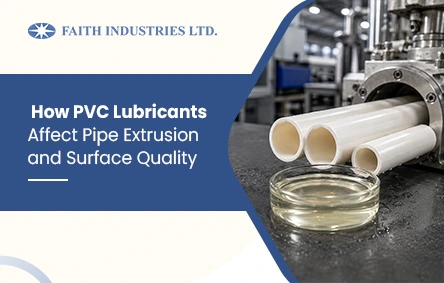
Good lubrication does much more than make PVC melt flow. In rigid PVC processing, high-performance pvc lubricants help reduce friction inside the melt and at the metal surfaces. That leads to smoother flow, less sticking to the screw or die, and more stable pressure during extrusion or molding.
In practical terms, better lubrication can cut energy use, reduce the frequency of die cleaning, and keep surface finish consistent all of which quietly lower the real cost of production. For example, balanced lubrication systems can reduce extruder torque and energy consumption while protecting equipment and reducing scrap.
Processors often notice fewer fluctuations in melt behavior and longer, trouble-free runs when the right lubricant system is in place.
Innovations in PVC Lubricants: What’s Actually Changing
PVC lubrication has changed mainly because processing conditions have changed. Older wax combinations were developed for slower lines and lower shear. When output speeds increase, those systems often fail to release evenly, leading to plate-out, pressure swings, and surface defects.
One key development is balanced internal–external lubrication systems. Instead of relying heavily on one type of wax, modern formulations split the role more precisely internal lubricants manage melt flow and shear, while external lubricants control metal release. This balance keeps the melt stable even at higher screw speeds.
Another shift is lubricants designed specifically for high-speed extrusion. These systems activate earlier and more consistently, helping maintain steady pressure and reducing sudden load on the extruder.
Low-plate-out formulations are also gaining ground. By reducing wax build-up on dies and calibrators, they allow longer production runs with fewer stoppages directly improving machine productivity and output consistency.
How Impact Modifiers and Lubricants Work Together
Impact modifiers and lubricants do not work independently inside a PVC formulation. The way an impact modifier performs depends heavily on how well it is dispersed, and that dispersion is strongly influenced by the lubricant system.
When lubrication is poorly balanced, the melt can become uneven. This leads to clusters of impact modifiers instead of uniform distribution. On paper, the formulation may look correct, but in practice the material shows weak spots, surface defects, or inconsistent impact results.
A well-matched lubricant system helps the modifier spread evenly during melting and fusion. Internal lubrication supports proper flow and mixing, while external lubrication prevents excessive shear at metal surfaces. Together, they allow the impact modifier to do its job effectively.
This balance is why formulation design matters more than individual additive selection and why treating additives as a system delivers better, more predictable performance.
What Processors and Buyers Should Look for When Evaluating New Additives
When evaluating new PVC additives, datasheets alone rarely tell the full story. What matters is how the additive behaves on the line, over time, and across batches.
Processors should first look at processing consistency. Does the formulation run smoothly at higher speeds without sudden pressure changes or surface defects? Additives that perform well only under ideal conditions often fail during long production runs.
Next is compatibility with existing formulations. An additive must work with the current resin grade, filler levels, and lubricant system, not disrupt them.
Buyers should also assess repeatability and technical support. Reliable suppliers provide consistent quality and help during trials and scale-up. Finally, field performance matters fewer handling failures and customer complaints often matter more than marginal gains in lab values.
The Road Ahead: Where PVC Additive Innovation Is Headed
What’s driving new PVC additive development today is simple: production cost and line reliability. Processors want formulations that run longer without stopping, cleaning, or adjustment. Anything that saves time on the machine matters more than theoretical performance gains.
Additives are now being developed to leave fewer deposits on screws and dies. Less build-up means fewer shutdowns and more usable hours per shift. Another clear direction is getting the same performance at lower dosage levels, which helps control formulation cost without sacrificing quality.
Recyclability is also becoming practical. Additives are increasingly judged by how PVC behaves after reprocessing whether impact strength and surface finish hold up in recycled material.
This direction isn’t about trends. It’s about what keeps plants running efficiently.
Conclusion
Innovation in PVC additives only matters when it solves real production problems. As an experienced pvc additives manufacturer, Faith Industries brings decades of hands-on knowledge into impact modifiers and lubricant systems that work reliably on the shop floor. Backed by in-house R&D and consistent quality, this practical approach is why processors in India and global markets continue to choose Faith Industries.