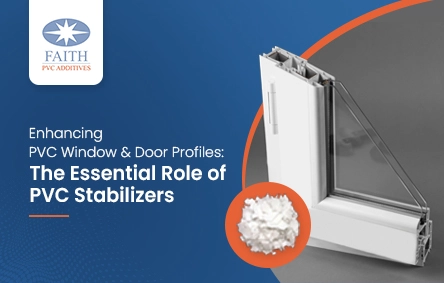
PVC window profiles are expected to perform consistently for 15–25 years, often in harsh outdoor conditions. Daily exposure to heat, UV radiation, dust, and seasonal temperature changes put constant stress on the material. Yet, many profile-related complaints early yellowing, surface dullness, weak welded corners, or processing inconsistency start appearing within the first few years of installation.
What often gets overlooked is that these issues are rarely caused by the profile design alone. In most cases, they trace back to formulation decisions made during compounding and extrusion. The stabilizer system plays a central role in how a PVC window profile behaves during processing and how it ages in real-world use.
A properly designed calcium zinc stabilizer for PVC does more than prevent degradation during extrusion. It influences melt behavior, surface appearance, and long-term resistance to heat and weathering. When selected and balanced correctly, a CaZn Stabilizer for Window profile helps producers achieve stable production and reliable performance in finished frames.
What Window Profile Producers Actually Struggle With
Despite using good-quality resin and modern extrusion lines, many window profile producers face recurring issues that slow production and impact finished quality. These problems are common across plants yet rarely discussed in detail.
Here are the real challenges producers deal with daily:
- Inconsistent extrusion during long runs
Output may start stable but gradually fluctuates due to thermal imbalance, especially when regrind is introduced. This forces operators to reduce line speed or stop the machine. - Surface defects that appear after cooling
Flow lines, dull patches, or uneven gloss often show up after calibration—not at the die. These issues affect lamination and customer acceptance. - Early yellowing in white profiles
Profiles may pass initial inspection but lose brightness after storage or outdoor exposure, leading to complaints from fabricators and end users. - Weak weld strength at window corners
Profiles crack or split during welding or installation, even when fabrication parameters are correct. - Higher rejection and rework rates
Small formulation instability leads to scrap, reprocessing, and higher overall production cost.
What makes these challenges frustrating is that they are often treated as processing problems, while the real cause lies in how the PVC is stabilized. Understanding this connection is the first step toward improving window profile performance and it starts at the formulation level.
Calcium Zinc Stabilizers: Beyond “Lead-Free” Positioning
Most window profile producers started using calcium zinc systems because regulations pushed them away from lead. That is only one part of the story. In real production conditions, CaZn stabilizers influence how smoothly you run the line and how the profile behaves years later.
What actually makes calcium zinc stabilizers different in window profiles:
- They work as a system, not a single ingredient
A cazn stabilizer combines metal soaps and organic components that activate at different stages of extrusion, offering controlled protection instead of sudden stabilization loss. - Better control during long, continuous runs
Window profiles carry higher thermal load due to thick walls and longer residence time. A properly balanced calcium zinc stabilizer for PVC helps maintain stable torque and melt flow without frequent operator intervention. - Reduced risk of sudden degradation
Unlike older stabilizer concepts, CaZn systems are designed to handle temperature fluctuations and recycled material more predictably. - Performance-driven, not just compliance-driven
When formulated correctly, CaZn stabilizers support surface quality, fusion behavior, and processing consistency issues window profile producers struggle with daily.
Thermal Stability Under Continuous Extrusion
Window profiles are not short-run products. They are extruded continuously for hours, often with regrind mixed in. This is where stabilizer performance is truly tested not in lab conditions, but on a running extrusion line.
What thermal stability really means for window profile producers:
- Stable torque over long production hours
When thermal protection is weak, torque slowly rises, forcing speed reduction or shutdown. A well-designed CaZn system helps keep torque predictable throughout the shift. - Controlled heat build-up in thick sections
Window profiles retain more heat than pipes or sheets. Poor stabilization leads to localized degradation inside the profile wall, even if the surface looks fine. - Better tolerance to temperature variation
Minor fluctuations at the barrel or die should not immediately affect output. Strong thermal buffering reduces sensitivity to these changes. - Safer use of recycled material
Reprocessed PVC carries a thermal history. Without proper stabilization, it accelerates degradation and color drift during extrusion.
Many producers assume thermal issues come from machine settings. Continuous extrusion exposes whether the stabilizer can protect PVC consistently not just at startup, but after hours of heat exposure. This is where formulation quality directly affects productivity and profile reliability.
Why CaZn Formulation Quality Matters
For window profiles, appearance is not cosmetic it is a quality benchmark. Even small surface defects or loss of whiteness can lead to rejection by fabricators or end users, regardless of mechanical performance.
How stabilizer formulation affects surface quality:
- Uniform melt flow at the die exit
An imbalanced stabilizer system can disturb melt lubrication, leading to flow lines, drag marks, or rough surfaces that appear after cooling. - Consistent initial whiteness
Poor stabilization can react with pigments, especially TiO₂, reducing brightness from the first production batch itself. - Whiteness retention during storage and exposure
Profiles that look fine at dispatch may slowly yellow due to ongoing thermal or oxidative degradation if stabilization is insufficient. - Improved lamination and foiling results
A smoother, chemically stable surface improves adhesive bonding and reduces defects during downstream processes.
Most surface problems are treated as tooling or lubrication issues. In practice, stabilizer quality plays a major role in how PVC behaves at the surface level long before the profile reaches the customer.
How CaZn Stabilizers Support Long-Term Outdoor Performance
PVC window profiles are constantly exposed to sunlight, heat, dust, and rain. Over time, this exposure can cause color fading, surface chalking, and reduced impact strength. While UV stabilizers are critical, a properly designed CaZn stabilizer for PVC plays an equally important supporting role.
How calcium zinc stabilizers improve outdoor durability:
- Prevents early degradation
Profiles that start degrading internally will yellow faster and lose mechanical strength. A balanced CaZn system protects the PVC matrix during extrusion, giving UV stabilizers a better foundation to work effectively. - Supports pigment stability
TiO₂ and other colorants are sensitive to heat and oxidation. A quality CaZn stabilizer reduces chemical reactions that lead to fading or uneven color. - Enhances long-term impact performance
Even if the profile surface is intact, poor stabilization can cause internal brittleness, making the frame more prone to cracks under stress. - Improves tolerance to temperature fluctuations
In regions with hot summers and cool winters, stabilizers help PVC withstand thermal expansion and contraction cycles without premature aging.
Most producers focus on UV stabilizers alone, but surface protection and thermal stability provided by CaZn systems are what make window profiles truly weather-resistant over 15–25 years. Understanding this connection helps fabricators choose stabilizers not just for compliance, but for real-life performance.
Weld Strength & Fabrication Performance: An Overlooked Advantage of Optimized CaZn Systems
While extrusion and surface quality get most of the attention, weld strength and fabrication performance are equally critical for window profiles. Weak corners, cracks during cutting, or poor fusion during welding can lead to costly rework or customer complaints.
How optimized CaZn stabilizers support fabrication:
- Improved fusion at welded joints
A well-balanced CaZn stabilizer ensures the PVC at corner welds retains sufficient molecular mobility, allowing stronger fusion without cracking. - Reduced brittleness in thick sections
Profiles with thick walls or multi-chamber designs are prone to micro-cracks if the stabilizer cannot evenly distribute thermal protection. Optimized CaZn systems prevent this. - Consistent processing behavior during fabrication
Heat from corner welding or machining can trigger localized degradation in poorly stabilized profiles. Proper CaZn formulations maintain uniform thermal resistance, reducing failures. - Supports post-extrusion operations
Drilling, cutting, or routing profiles becomes more predictable when the PVC is chemically stable, reducing scrap and increasing productivity.
Lead vs Calcium Zinc for Window Profiles
Choosing the right stabilizer isn’t about compliance alone—it’s about matching performance to real production and outdoor durability needs. Here’s a practical comparison:
| Feature / Property | Lead Stabilizers | Calcium Zinc (CaZn) Stabilizers |
| Thermal stability during extrusion | High initial stability, long melt window, smooth flow | Modern CaZn systems provide comparable stability for long runs, thick sections, and recycled content |
| Surface whiteness & gloss | Naturally maintains surface brightness | Achieves high whiteness and uniform surface when properly formulated; better long-term color retention |
| Outdoor performance | Limited UV and thermal resistance; prone to yellowing over years | Enhanced resistance to UV, thermal cycling, and weathering when combined with pigments and UV absorbers |
| Health & environmental safety | Toxic, requires careful handling and disposal | Non-toxic, easier to handle, aligns with global environmental standards |
| Fabrication & weld strength | Good fusion, but brittleness possible under stress | Supports stronger corner welds and reduces micro-cracks due to optimized thermal and chemical balance |
| Regulatory compliance | Restricted or banned in many regions | Fully compliant with modern environmental and safety regulations |
Choosing the Right Calcium Zinc Stabilizer for PVC Window Profiles
Selecting the right CaZn stabilizer for PVC is more than picking a product off the shelf it’s about matching the stabilizer system to your specific window profile design, processing conditions, and long-term performance goals. The wrong choice can lead to surface defects, extrusion instability, or reduced outdoor durability, even if all other parameters are optimal.
Key factors to consider when choosing a CaZn stabilizer:
- Profile thickness and design
Thicker or multi-chamber profiles retain more heat during extrusion. A stabilizer system must provide consistent protection across different wall sections to prevent internal degradation. - Production speed and extrusion setup
High-speed lines and long runs require stabilizers that maintain melt stability and torque consistency. Some CaZn systems perform better at steady-state conditions than others. - Environmental exposure
Profiles used in high UV or hot climates need stabilizers that enhance resistance to yellowing and maintain mechanical strength over time. - Reprocessed material content
Regrind introduces thermal history into the mix. A carefully formulated CaZn stabilizer can buffer recycled PVC, maintaining uniform color and surface quality. - Compatibility with other additives
Lubricants, waxes, pigments, and UV absorbers interact with stabilizers. Choosing a stabilizer that works seamlessly with your full formulation is crucial. - Technical support and customization
Partnering with an experienced PVC stabilizer manufacturer ensures the stabilizer system can be tailored to your profile requirements, avoiding costly trial-and-error.
How Faith Industries Ltd. Approaches CaZn Stabilizer Solutions for Window Profiles
At Faith Industries Ltd., we don’t treat calcium zinc stabilizers as generic products; we see them as performance solutions that directly impact window profile quality and longevity. With over four decades of experience as a trusted PVC additives manufacturer, our team combines deep technical expertise with hands-on production insights to develop stabilizer systems tailored to each client’s needs.
Our approach begins with understanding the profile design, extrusion conditions, and end-use environment, allowing us to recommend CaZn systems that optimize thermal stability, surface finish, weld strength, and long-term weathering performance. Unlike many competitors who offer off-the-shelf solutions, we focus on customized formulations supported by rigorous in-house R&D and modern SCADA-controlled offering processes. This ensures consistent quality across every batch while providing technical support during trials and scale-up. By partnering with Faith Industries, producers benefit from solutions that enhance productivity, reduce defects, and deliver durable, high-quality PVC window profiles that perform reliably for years.