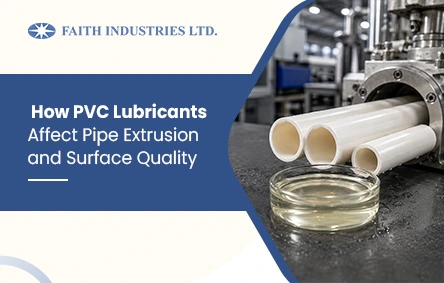
PVC pipe extrusion depends on getting several processing conditions right at the same time. The compound must fuse properly, move smoothly through the extruder and pass through the die without creating excessive friction or deposits. PVC lubricants have a direct role in maintaining this balance. Research on rigid PVC processing has shown that the type and ratio of lubricants can change fusion behaviour, torque and processing stability.
The effect is also visible in the finished pipe. A lubricant balance that is too low or too high can affect surface smoothness, gloss, die release and extrusion consistency. For this reason, lubricant selection should not be based only on friction reduction. The better approach is to look at the complete chain: lubricant balance → fusion and melt behaviour → extrusion stability → pipe surface quality. Understanding this relationship helps manufacturers identify processing problems and make better formulation decisions.
How PVC Lubricants Influence Pipe Extrusion
Lubrication and PVC Fusion
During PVC pipe extrusion, the compound must reach the right level of fusion before it leaves the die. Lubricants have a role in controlling how quickly this happens. More lubricant does not automatically mean easier processing. If external lubrication is too strong, it can delay fusion; if lubrication is insufficient, friction between the PVC particles and processing surfaces can increase.
Research on hydrocarbon waxes in PVC pipe formulations found that wax type, concentration and processing temperature can change fusion behaviour and fusion torque. The study also showed that some higher-melting waxes can provide low torque but have a narrower processing range.
For pipe manufacturers, this points to an important lubrication–fusion balance. The aim is not to use the highest possible lubricant level, but to give the compound enough lubrication while allowing fusion to develop at the required stage of extrusion.
Effect on Extrusion Torque and Melt Flow
Extrusion torque gives the operator useful information about how the compound is behaving inside the machine. When lubrication changes, the resistance to processing can change as well. Studies on PVC extrusion have measured changes in both torque and melt pressure with different lubricant systems and dosage levels.
A rise in torque should not immediately be treated as an extruder problem. The formulation, lubricant level, fusion behaviour and processing temperature should also be checked. Likewise, a sudden drop in torque can indicate a change in lubrication or melt behaviour.
This makes torque a useful production signal: torque change → check formulation and processing conditions → then adjust the cause, not just the machine setting.
Lubricants and Die Release
At the die, lubrication affects how easily the PVC melt moves across the metal surface. Poor balance can increase sticking, surface marks or deposits, while suitable lubrication helps maintain steady material flow.
Plate-out is also worth watching. Research has shown that lubricant effects can influence the formation of deposits on extrusion tooling. If deposits begin building on the die during a production run, the lubricant system should be one of the formulation factors investigated, not simply treated as a die-cleaning issue.
How Lubricant Balance Affects PVC Pipe Surface Quality
Smoothness, Gloss and Surface Appearance
A smooth PVC pipe surface is not produced by lubricant alone. The final appearance depends on how the PVC compound behaves while passing through the die. Lubricant balance can change the way the melt moves across the die surface, which can affect smoothness, gloss and overall appearance.
This is why the same lubricant may give different results in two pipe formulations. PVC resin grade, stabilizer system, filler loading, processing temperature, screw design, extrusion speed and die condition can all change the result. A lubricant that performs well in one formulation may need a different dosage or combination in another.
Polyethylene waxes are used in rigid PVC pipe processing for external lubrication, and technical data for some grades also reports improvements in surface gloss and release. But this should not be taken to mean that adding more wax will always produce a better surface. Surface quality is an outcome of the complete formulation and processing conditions, not a property of the lubricant by itself.
For a pipe manufacturer, this distinction matters when a previously stable formulation suddenly produces a duller, rougher or less uniform surface. The first step should be to compare the complete processing conditions rather than changing the lubricant blindly.
Rough Surface, Die Lines and Uneven Appearance
Visible defects can provide useful clues, but they do not have a single cause. A rough surface, for example, may be linked to lubrication, fusion, temperature, die condition or material dispersion. The lubricant system should therefore be treated as one part of the troubleshooting process.
| Surface observation | Possible lubrication-related cause |
| Rough or uneven surface | Low lubrication or an unsuitable lubrication–fusion balance |
| Dull surface | Change in lubricant balance, fusion behaviour or processing conditions |
| Die lines or marks | Die deposits, material flow or lubricant-related die interaction |
| Variation in surface appearance | Inconsistent formulation, dispersion or lubricant distribution |
| Increasing die deposits | Possible plate-out or excessive migration of formulation components |
The useful question is not simply “Which lubricant gives a smooth pipe?” but “What changed in the formulation or processing conditions that changed the pipe surface?”
Checking lubricant dosage, raw-material batches, stabilizer level, processing temperature, extrusion speed and die condition together can provide a much clearer answer. This approach helps manufacturers correct the actual cause instead of making repeated formulation changes without knowing why the surface changed.
What Happens When PVC Lubricant Levels Are Too Low or Too High?
The amount of lubricant used in a PVC pipe formulation can change how the compound behaves inside the extruder. Too little lubrication can increase friction and processing resistance, while too much can interfere with fusion and change the way the melt behaves. The right level depends on the complete formulation and processing conditions.
When Lubrication Is Too Low
When the lubricant level is insufficient, the PVC compound may experience greater friction during processing. This can increase the load on the extruder and may show up as higher torque or less stable processing.
Possible signs include:
- Higher extrusion torque
- Greater resistance during processing
- More interaction between the PVC melt and metal surfaces
- Rough or uneven pipe surfaces
- Less consistent extrusion
- Greater tendency for deposits to develop on processing surfaces
These signs should not automatically be blamed on low lubricant. Resin changes, filler loading, temperature and other formulation changes can produce similar effects.
When Lubrication Is Too High
Excessive lubrication can create a different problem. Strong external lubrication may reduce friction but can also delay the development of proper PVC fusion. Technical data for several PVC wax lubricant systems shows that external lubrication and fusion behaviour need to be balanced rather than maximized.
Possible results include:
- Delayed fusion
- Changes in melt flow
- Unstable extrusion behaviour
- Variation in pipe surface appearance
- Greater risk of plate-out or die deposits
- Reduced processing consistency
Why Balance Matters More Than Maximum Lubrication
The goal is not to use as much lubricant as possible. The objective of a PVC lubricant system is controlled lubrication at the right stage of processing.
A useful way to view the relationship is:
Too little lubrication → higher friction and processing resistance → Optimum balance → controlled fusion and stable extrusion → Too much lubrication → delayed fusion or altered melt behaviour
This is why lubricant dosage should be assessed through actual production results such as torque, fusion behaviour, surface appearance, die deposits and output—not by dosage alone.
How to Troubleshoot PVC Pipe Surface Problems Related to Lubrication
A change in pipe appearance is often the first sign that something has shifted in the formulation or extrusion process. The right troubleshooting approach is to start with the visible problem and then check the factors that could have caused it. Lubricant dosage is one of those factors, but it should not be checked in isolation.
Rough or Uneven Pipe Surface
Check the lubricant dosage and internal/external balance first. Then compare fusion behaviour, processing temperature and screw speed with the normal production settings. The die should also be inspected for wear, contamination or deposits.
Increasing Die Deposits
Check the external lubricant level and whether the lubricant is compatible with the rest of the formulation. Also review dispersion, processing temperature and any recent changes to the stabilizer or other additives. A sudden increase in deposits can be a formulation change as much as a die-cleaning issue.
Sudden Change in Extrusion Torque
Start by checking lubricant batch consistency and dosing accuracy. Then compare the current PVC resin and filler levels with the previous batch. Fusion behaviour and processing conditions should also be reviewed before changing the lubricant level.
Surface Appearance Changes Between Batches
Compare the raw-material batches, lubricant quality, addition sequence and mixing conditions. If these remain consistent, check processing temperature, extrusion speed and die condition.
The practical rule is simple: compare the current production run with a stable reference run. This helps identify what changed before making a formulation adjustment and reduces trial-and-error changes on the production floor.
How to Select PVC Lubricants for Consistent Pipe Extrusion
Selecting a lubricant for PVC pipe production should start with the formulation, not with the lubricant name alone. A lubricant that performs well in one pipe compound may give different results when the resin, stabilizer, filler level or processing conditions change. The same applies to extruder design, die geometry, production speed and the surface finish expected from the finished pipe.
Evaluate the Lubricant Against the Pipe Formulation
Before changing a lubricant, review the complete compound. Consider the PVC resin characteristics, stabilizer system, filler and impact modifier levels, processing temperature and the type of extrusion equipment being used. Desired output and surface requirements also matter.
This helps explain why a lubricant should not be judged from its chemical description alone. Its practical value comes from how it behaves with the complete PVC formulation.
Look at Processing Data, Not Only Product Specifications
A product specification can provide useful information, but production results tell you much more. During trials, compare extrusion torque, melt pressure, fusion behaviour, output rate, die deposits, surface appearance and dimensional consistency with the existing lubricant system.
A useful evaluation sequence is:
Specification → controlled trial → processing data → pipe inspection → production validation
This gives the manufacturer a clear basis for deciding whether the lubricant actually improves the process.
Why Formulation Trials Matter
A proper trial should use the actual PVC resin, stabilizer, filler level, extruder, die, temperature profile and production speed. The objective is to confirm performance under real manufacturing conditions, not only in a laboratory test.
Different wax chemistries can provide different levels of lubrication, fusion control and metal release. Comparing them under the same production conditions gives a more reliable picture of which system provides stable processing and consistent pipe quality.
Why Choose Faith Industries Ltd. for PVC Lubricants?
Established in 1975, Faith Industries Ltd. is an Indian manufacturer and exporter of PVC stabilizers and additives, with PVC lubricants and waxes forming part of its product range. Its portfolio includes paraffin and microcrystalline waxes used in PVC processing. The company operates a fully automated, SCADA-controlled plant and has a modern in-house R&D centre supporting its product development and technical capabilities.
Faith Industries’ experience covers more than lubricants alone. Its range of PVC stabilizers, lubricants and other additives provides a broader understanding of PVC formulations, where these components need to work together during processing. As PVC Stabilizer Manufacturer, Faith Industries combines this product knowledge with products exported to more than 35 countries and a sales network across India and international markets.